 INR ₹
INR ₹
 USD $
USD $ EUR €
EUR € GBP £
GBP £


Table of Contents
- Introduction
- Understanding the Ear: Placement Matters
- Understanding the Language of Ear Curation
- Principle 1: Define the Architecture of Your Curated Ear Before You Create It
- Principle 2: Build the Composition from the Foundation Upwards
- Understanding the Ear as a Design Surface
- The Power of Negative Space
- Choosing Jewellery That Serves the Architecture
- The Curated Ear Design Checklist
- Metal Harmony: Creating Visual Unity
- Conclusion: A Curated Ear Is Designed, Not Collected
- Frequently Asked Questions
The Totapari Earrings Series
Ear piercing is more than wearing earrings. It gathers history, culture, science, craftsmanship, health and personal style into one small place on the body. Each guide in this series takes one part of that and follows it properly.
- The Ear, the Face, and Adornment
- Karnavedha: The Cultural, Ayurvedic and Scientific Foundations of Ear Piercing
- Piercing Guns vs. Needles vs. Medical Piercing: A Complete Ear Piercing Guide
- Ear Piercing Aftercare: Healing Science, Hygiene Protocols and Long-Term Care
- Best Metal for Ear Piercing: A Guide to Gold, Silver and Hypoallergenic Earrings
- Types of Earrings: A Complete Guide (to be published soon)
- How to Choose Earrings for Your Face Shape
- Earrings and Hairstyles: Understanding the Relationship (to be published soon)
- Earrings and Necklines: Understanding the Relationship
- The Curated Ear: Structural Aesthetics and Biomechanical Design of the Auricular Space (You are here)
- Earrings for Every Occasion
- Gold, Silver or Gemstone Earrings: Which Should You Choose? (to be published soon)
- How to Care for Earrings and Prevent Tarnish (to be published soon)
- How to Choose Earrings for Everyday Wear (to be published soon)
- The History of Earrings: From Ancient Power to Modern Personal Style
- Why Did Sailors Wear Earrings? The History of the Gold Hoop in Men’s Jewellery
“A curated ear is the meeting point of anatomy, jewellery and design. Remove any one of the three, and the composition loses its integrity.”
Introduction
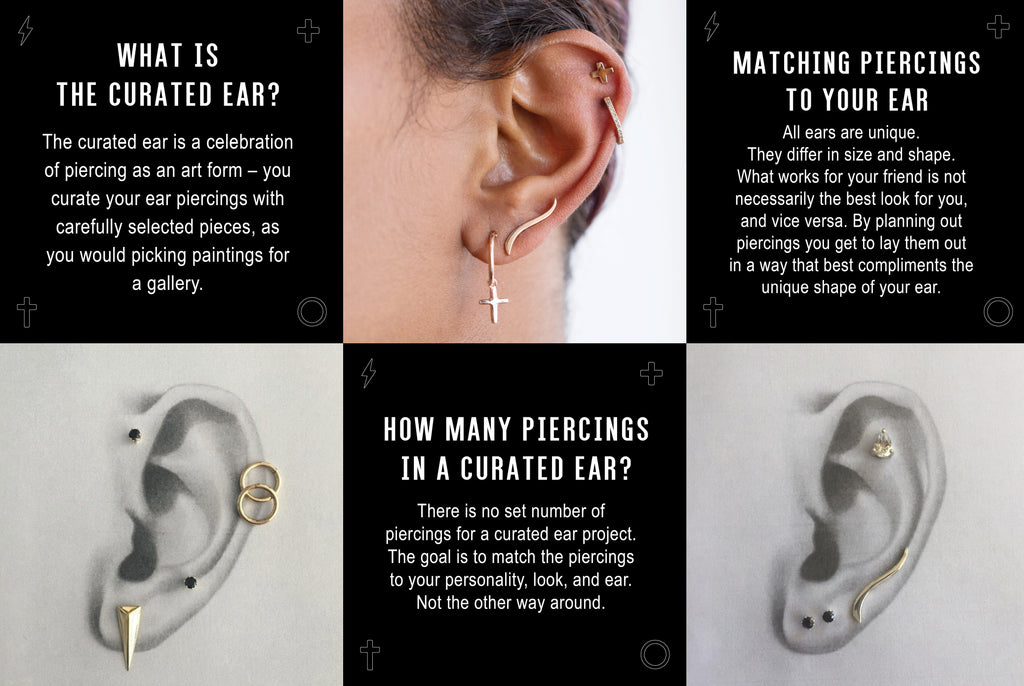
A curated ear is the intentional arrangement of multiple earrings and piercings so that they function as one complete composition rather than as isolated ornaments. Each placement is considered in relation to the anatomy of the ear, the jewellery around it and the visual balance of the whole.
The number of piercings does not determine whether an ear is curated. A person may have only two or three piercings along the lower and upper lobe, while another may have jewellery distributed across the helix, conch, tragus, rook and other parts of the ear. In both cases, curation begins only when every placement has a clear function within the composition.
This makes the ear a particularly complex design surface. Unlike a neckline, which largely acts as a two-dimensional frame, the ear has curves, folds, projections, recesses and anatomical zones with different visual and structural roles.
The lobe may provide the anchor, the upper lobe may create transition, the conch may introduce depth, and the helix may define the outer boundary of the arrangement.
A successful curated ear therefore cannot be created by adding piercings wherever space is available. It requires an understanding of how the eye moves across the ear and how space separates one element from another
The article develops the principles that govern ear curation. They remain the same whether the composition contains three piercings or fifteen. What changes is only the degree of complexity. As more jewellery is added, every new placement must justify its presence by strengthening hierarchy, transition, depth, balance, rhythm or cohesion.
Totapari's personal choice is not having more than 5 piercings, otherwise it looks a drama.


Understanding the Ear: Placement Matters
The ear is not a uniform surface. It contains soft tissue, curves, folds, projections and recessed areas, and each region performs a different function within a curated composition. Successful ear curation begins by understanding these differences and using every placement according to the role it can perform.
First Lobe Piercing
Role: The visual foundation of the composition.
The first lobe piercing establishes the visual identity of the curated ear. It is usually the first element the eye notices and serves as the foundation upon which the rest of the composition is built. Because the lobe consists of soft tissue, it can generally support larger, heavier or more expressive earrings more comfortably than the cartilage above.
Upper Lobe
Role: The transition between the lower and upper ear.
The upper lobe connects the visual weight of the lower ear with the lighter cartilage placements above. It creates a smooth transition, allowing the eye to move naturally upwards without breaking the flow of the composition. Jewellery here should complement the foundation rather than compete with it.
Helix
Role: Defining the upper extent of the composition.
The helix forms the outer rim of the upper ear and determines how far the composition extends vertically. Jewellery placed here completes the upward movement created by the lobe and upper lobe, giving the curated ear a clear visual finish. Small studs, closely fitted hoops and ear cuffs generally work well because they define the outline without making the upper ear appear heavy.
Forward Helix
Role: Counterbalancing the outer ear.
The forward helix sits on the inner front edge of the upper ear. Its primary function is to balance jewellery placed along the outer helix so that the composition does not appear visually weighted towards one side. Even a small piece can create this balance because of its prominent position.
Tragus
Role: The inner point of balance.
The tragus projects towards the face and introduces a subtle point of visual interest along the inner edge of the ear. Although small, it helps balance the larger elements positioned on the lobe and outer ear without competing for attention.
Rook and Daith
Role: Creating internal complexity.
The rook and daith occupy the natural folds within the ear. Jewellery placed here adds another layer to the composition, making the arrangement feel richer and more considered. Since these areas are already visually intricate, smaller and well-proportioned pieces generally produce the most harmonious result.
Conch
Role: Unifying the lower and upper ear.
The conch occupies the central region of the ear between the lower and upper ear. Its principal function is to bring the entire composition together into one complete unit. Without a well-balanced central element, the jewellery on the lobe and the upper ear can appear like two separate arrangements. A thoughtfully chosen conch earring visually connects these regions and gives the curated ear balance, unity and completeness.
The conch is not simply another piercing. It is the element that visually unifies the lower and upper ear into one complete composition. If the lower lobe is the focal point make the conch light and if the upper helix is the focal point then make the conch transition point.
| Region of the Ear | Primary Function in Curation | Typical Jewellery Role |
|---|---|---|
| First Lobe | Anchor | Introduces the principal visual weight and establishes the character of the composition. |
| Upper Lobe | Transition | Guides the eye from the anchor towards the cartilage placements above. |
| Helix | Outer Boundary and Height | Extends and refines the composition along the outer curve of the ear. |
| Forward Helix | Upper Inner Balance | Balances outer placements and adds controlled detail near the top of the ear. |
| Conch | Depth | Brings jewellery into the central recess and creates dimensional balance. |
| Tragus | Inner Counterpoint | Adds a small but prominent point of interest close to the face. |
| Rook and Daith | Internal Detail | Add architectural complexity within the inner folds of the ear. |
The visual function of an ear placement can be understood as a progression: the lobe establishes the anchor, the upper lobe creates transition, the conch introduces depth, the helix defines the outer boundary, and the inner cartilage placements add balance and detail.
A balanced curated ear does not require jewellery in every anatomical zone. A composition restricted to two or three lobe piercings may be complete if the anchor, transition and spacing are properly resolved. A more complex ear may extend into the conch, helix, tragus or inner folds, but every additional placement should strengthen the composition rather than merely occupy available space.
Understanding the anatomy of the ear therefore provides the vocabulary for curation. Once the role of each region is clear, the later decisions involving hierarchy, visual weight, spacing, movement and repetition become easier to understand and apply.
Understanding the Language of Ear Curation
Before discussing the principles of ear curation, it is helpful to become familiar with a few design terms that will be used throughout this article. These concepts are widely used in design, architecture and visual composition, and understanding them will make the principles of ear curation much easier to follow.
Anchor
The principal visual focal point of the composition. It is usually established by the first lobe piercing and introduces the overall character of the curated ear.
Transition
The gradual movement from one area of the composition to another. In ear curation, the upper lobe often acts as the transition between the main anchor and the cartilage piercings.
Depth
The perception of three-dimensionality. Jewellery placed in the conch introduces visual depth by drawing the eye into the centre of the ear rather than only around its outer edge.
Boundary
The outer limits of the composition. Helix piercings often define the upper boundary and give the arrangement height.
Visual Weight
The amount of attention an earring attracts. Size, colour, sparkle, movement, contrast and placement all influence visual weight.
Negative Space
The empty areas between earrings. These spaces allow each piece to remain visible and prevent the composition from appearing crowded.
Rhythm
The visual flow created by repeating shapes, sizes, metals or spacing. Rhythm allows the eye to travel naturally across the composition.
Balance
The distribution of visual weight across the ear so that no single area appears unnecessarily heavy or empty.
Principle 1: Define the Architecture of Your Curated Ear Before You Create It
A curated ear should not emerge from a series of unrelated piercings. Before the first additional piercing is made, decide what kind of complete composition you ultimately want to create.
Most people do not begin with a plan. They get one piercing, then another, and later add a third because a particular earring appeals to them or because an empty area of the ear appears available. Over time, the ear grows through separate decisions rather than through one coherent design. This leads to cluttered ear.
True curation begins earlier. It begins before the piercing needle touches the ear.
The first question is not:
Where should the next piercing go?
The first question is:
What kind of curated ear do I want to create?
This decision defines the architecture of the ear. Some people may want a restrained composition limited to the lower lobe, upper lobe and perhaps the lower helix. Others may want a more extended composition involving the conch, tragus, forward helix, rook or daith. Neither is superior. The important point is that the intended extent of the composition should be understood before the piercings are planned.
Minimal Architecture
A minimal curated ear may consist of two or three carefully spaced lobe piercings, perhaps extending into the upper lobe or lower helix. Its strength comes from restraint. Hierarchy, proportion and spacing must be particularly precise because every element is clearly visible and there are fewer pieces to create balance.
Extended Architecture
An extended curated ear may travel from the first lobe through the upper lobe and into selected cartilage zones. It may use the helix to create height, the conch to add depth or the tragus to introduce an inner point of balance. The composition becomes richer, but it must still remain controlled.
Complex Architecture
A complex curated ear may involve several anatomical zones across the outer and inner ear. Complexity, however, does not mean filling every available space. The more piercings a composition contains, the greater the need for hierarchy, repetition, negative space and visual discipline.
The purpose of defining the architecture is not to lock the ear into an inflexible plan. A curated ear may evolve over time. The purpose is to ensure that each stage of that evolution moves towards a recognisable whole.
Once the overall architecture is clear, several later decisions become easier:
- Placement: which anatomical zones should be used and which should remain empty.
- Sequence: which piercings should be created first and which can be added later.
- Hierarchy: where the principal anchor and secondary focal points should sit.
- Spacing: how much visual and physical room each placement requires.
- Jewellery: which pieces should carry weight, movement, colour or detail.
- Healing: how the curation can be developed gradually without overloading the ear.
A plan also prevents a common problem: reaching a later stage and discovering that an earlier piercing has occupied the exact space needed for a more important placement. Because piercing locations cannot be moved like jewellery on a necklace, early decisions have long-term consequences.
This is why ear curation resembles architecture. A building is not designed by choosing one window, then a door, then another room without considering the final structure. The whole is imagined first, and the individual elements are placed in relation to that whole.
The architecture does not determine how many piercings you must have. It determines where the composition begins, how far it travels, where it gains depth and where it should stop. It should be neatly demonstrated and documented.
A curated ear therefore begins not with a piercing, but with a vision. Once that vision is clear, every later piercing becomes part of a plan rather than an isolated act.

A Very Pretty and Balanced Curated Ear with the Lobe as the Focal Point. I would have liked the loop from the daith replaced by a simple stud and one simple loop moving on the upper helix or the forward helix to give a more balanced look. This is an image from the net.
Principle 2: Build the Composition from the Foundation Upwards
Once the architecture of the curated ear has been defined, the composition should be developed in a logical sequence. Establish the foundation first, then create transition, height, depth and refinement.
Defining the architecture gives you a vision of the completed ear. The next question is how that vision should be translated into actual piercings.
A curated ear should not be built by piercing whichever area appears attractive at the moment. Nor should every desired placement be created at once. Like any successful structure, it should develop from a stable foundation, with every later addition responding to what has already been established.
The Lobe Establishes the Foundation
In most curated ears, the first lobe piercing provides the visual foundation. It usually carries the principal earring, introduces the dominant character of the composition and establishes the point from which the eye begins its journey.
The foundation does not necessarily have to contain a large or dramatic earring. Its importance comes from its position and its ability to organise the jewellery around it. Even a restrained stud can act as an effective anchor when the remaining pieces are designed in relation to it.
The Upper Lobe Creates Transition
Once the foundation is clear, the composition can move into the upper lobe. This area should not look like a sudden second beginning. Its role is to create a gradual transition between the principal lobe earring and the cartilage zones above.
The spacing, size and visual weight of these earrings should allow the eye to travel naturally. Each placement should feel like the next step in the same composition rather than another independent ornament.
The Helix Introduces Height
A helix or lower-helix placement allows the composition to rise along the outer curve of the ear. This may be sufficient for someone who wants a restrained curated ear limited to the lobe, upper lobe and outer boundary.
Height should be added only to the extent required by the architecture defined in the first principle. A minimal composition may stop at the lower helix. A more extended composition may continue towards the upper helix or forward helix.
The Conch Introduces Depth
If the composition needs to move beyond a simple upward line, the conch can bring jewellery into the centre of the ear. This adds depth and prevents the entire design from remaining confined to the lobe and outer rim.
Depth should be introduced deliberately. A conch placement is visually prominent because of its central position and may become a secondary focal point. It should therefore support the principal anchor rather than compete with it.
Inner Placements Add Refinement and Complexity
The tragus, rook, daith and forward helix should generally be considered after the larger structure has become clear. These placements add inner balance, detail and architectural complexity, but they should not be used merely because an anatomical space is available.
In a complex curated ear, these smaller interior placements can complete the composition. In a minimal or moderately extended ear, they may not be required at all.
The Natural Sequence of Ear Curation
Foundation
First lobe
Transition
Upper lobe
Height
Helix
Depth
Conch
Refinement
Inner details
How to read this diagram: it should not be treated as a recommendation to use every available piercing point. It is a planning map. Select only those zones required by the architecture you have chosen, and leave the remaining areas intentionally unpierced.
Building Upwards Does Not Mean Using Every Zone
The sequence from foundation to refinement is a way of thinking, not a compulsory list of piercings. A composition may become complete after the lobe and upper lobe. Another may need a lower helix to gain height. A third may require a conch to introduce depth.
The architecture defined in the first principle determines how far the composition should travel. Principle 2 determines how it should reach that destination.
Develop the Ear in Stages
A planned curated ear does not need to be completed in one sitting. In fact, gradual development is usually more intelligent. It allows each stage to heal and gives you an opportunity to examine how the composition looks before the next permanent placement is added.
After every stage, observe the ear as a whole:
- Does the foundation remain visually clear?
- Does the upper lobe create a natural transition?
- Does the composition need greater height?
- Would a central placement add useful depth?
- Is another piercing necessary, or is the composition already complete?
This gradual approach also prevents an early placement from occupying the space required for a more important future piercing. Jewellery can be changed, but the position of a piercing is permanent. The sequence therefore has to be planned with the final composition in mind.
Do not ask, “Which part of the ear should I pierce next?” Ask, “What does the composition need next?” It may need height, depth, transition or nothing at all.
A curated ear is therefore built progressively. The foundation comes first, the larger structure follows, and refinement comes only after the composition can support it. The objective is not to reach the top of the ear or to occupy every anatomical zone. The objective is to complete the architecture you originally envisioned—no more and no less.


Understanding the Ear as a Design Surface
The ear is not a flat surface where earrings are simply placed. It is a three-dimensional structure with an outer boundary, a central bowl, inner folds and softer lobe areas. Each of these regions contributes differently to the architecture of a curated ear.
Some areas establish the foundation. Others help the composition rise, move inward or gain refinement. Once these roles are understood, the question is no longer simply, “Where can another piercing be added?” The better question becomes, “What does the composition need, and which part of the ear can provide it?”
The anatomy of the ear provides the structure. Ear curation gives that structure a visual purpose.
The Lower Lobe: Foundation and Visual Weight
The lower lobe is usually where the composition begins. It has enough space to carry a more prominent earring and often establishes the visual weight of the entire ear. A solitaire, drop, hoop or compact cluster may all perform this role.
The foundation should not be understood as one earring physically supporting everything above it. It is the lower arrangement that gives the eye a clear starting point and establishes the character of the composition.
The Upper Lobe: Transition and Rhythm
The upper lobe connects the foundation to the cartilage above. Small studs, tiny hoops or graduated stones can create a smooth visual movement from the lower lobe towards the helix.
This region is important because it prevents the ear from appearing divided into two unrelated parts—lobe jewellery below and cartilage jewellery above. Good spacing and gradual changes in scale allow the composition to rise naturally.
The Helix: Height and Outer Boundary
The helix follows the outer rim of the ear. A piercing here introduces height and helps define the outermost boundary of the composition. It tells the eye how far upwards and outwards the design is intended to travel.
A lower-helix placement may be enough for a restrained composition, while an upper or forward helix can extend the architecture further. The helix should not be added merely because space is available; it should establish a deliberate limit.
The Flat: Upper Balance and Refinement
The flat is the broad area inside the upper cartilage. It is well suited to small decorative studs, clusters or motifs that add detail without creating another heavy focal point.
Its role is often one of refinement. It can balance visual weight in the lower half of the ear and complete the upper composition with a quiet point of interest.
The Conch: Central Depth
The conch occupies the central bowl of the ear. Jewellery placed here draws the eye away from the outer rim and into the centre, creating visual depth.
A conch stud may create a central focal point, while a conch hoop can connect the inner ear with the outer boundary. Because of its prominent position, conch jewellery should support the composition rather than compete with every other element.
The Daith: Inner Depth and Focus
The daith sits within an inner fold of the ear. A ring placed here creates a strong inward movement and can become an important secondary focal point.
In a composition that otherwise follows the lobe and outer helix, the daith prevents the design from appearing flat or linear. It brings the eye into the internal architecture of the ear.
The Tragus: Inner Counterbalance
The tragus is a small but visually important area near the entrance of the ear canal. A delicate stud here can balance jewellery placed on the outer rim or lower lobe.
Because the tragus occupies a forward inner position, even a very small piece can have a noticeable effect. It is usually most successful when used as a point of balance rather than as the principal feature.
The Forward Helix: Direction and Fine Detail
The forward helix sits near the front upper curve of the ear. One or more small piercings here can direct the eye towards the face and soften the transition between the upper ear and hairline.
It is best used with restraint. Forward-helix jewellery often works as a finishing detail once the larger architecture has already been established.
| Ear Region | Primary Architectural Role | What It Contributes |
|---|---|---|
| Lower Lobe | Foundation | Visual weight and a clear starting point |
| Upper Lobe | Transition | Rhythm and upward visual movement |
| Helix | Height and Boundary | Defines the outer limit of the composition |
| Flat | Refinement | Upper balance and decorative detail |
| Conch | Depth | Creates central dimension and inner focus |
| Daith | Inner Depth | Pulls the eye into the internal structure |
| Tragus | Counterbalance | Balances outer or lower-ear jewellery |
| Forward Helix | Direction | Draws the composition towards the face |
These roles are not rigid rules. The same piercing may serve a different function depending on the jewellery, spacing and surrounding placements. The purpose of this framework is to help you see the ear as one complete design surface rather than as a collection of available piercing points.
Once you understand what each region can contribute, planning a curated ear becomes more deliberate. You can decide where the composition should begin, how it should rise, where it should move inward and which areas should remain intentionally empty.

The Power of Negative Space
One of the most common mistakes in ear curation is assuming that every available part of the ear should eventually hold jewellery. It should not.
Just as silence gives meaning to music and empty space allows a painting to breathe, unoccupied areas of the ear allow each earring to remain visible and meaningful. Negative space is not an absence of design. It is one of the most important tools within the design.
A beautifully curated ear does not feel complete because every available piercing location has been occupied. It feels complete because the composition knows where to stop.
Empty Space Allows Jewellery to Be Seen
When earrings are placed too closely together, their outlines begin to merge. Stones, hoops and motifs may all be individually beautiful, but the eye is no longer able to appreciate them separately. The composition starts feeling crowded rather than layered.
Adequate space gives each piece its own visual identity. It allows the shape of the jewellery, the natural anatomy of the ear and the relationship between different placements to remain clear.
Negative Space Creates Hierarchy
Visual hierarchy depends not only on the size of the jewellery but also on the space surrounding it. A focal piece becomes more powerful when nearby placements remain quieter and less crowded.
A bold conch placement or distinctive central stud may act as a secondary focal point, while the surrounding piercings remain intentionally restrained. The empty space around that piece allows the eye to recognise its importance without creating competition.
Space Helps the Eye Travel
A successful curated ear should guide the eye naturally from one area to another. The spaces between piercings create pauses within that visual journey. Without those pauses, the composition becomes visually hurried.
Graduated spacing can create rhythm. Closer placements may form a compact lower-lobe cluster, while slightly wider spacing towards the upper ear can make the composition feel lighter as it rises.
The Rule of Three
The widely used Rule of Three can help create natural movement. Odd-number groupings often feel more organic and less rigid than perfectly even arrangements.
This may appear as three graduated lobe piercings, three related motifs or three points of visual interest distributed across the ear. The rule is not compulsory, but it can create rhythm and prevent the arrangement from feeling mechanically symmetrical.
The Rule of Three works best when the three elements are related but not identical. Repetition creates unity, while variation keeps the composition alive.
Spacing Is Also Biological
Spacing is not only a visual concern. Piercings placed too closely together may create pressure during healing, especially when swelling occurs or when jewellery needs sufficient room to sit comfortably.
Every ear has different anatomy. The thickness of the cartilage, the shape of the folds and the available surface area should determine how closely piercings can be placed. A design should never force the anatomy to accommodate a visual idea that the ear cannot comfortably support.
Knowing Where to Stop
Negative space is ultimately an act of restraint. It requires the confidence to leave an area unpierced even when another piece of jewellery could technically fit there.
Before adding another piercing, ask whether the composition genuinely needs greater height, depth, movement or balance. If the new placement serves no clear purpose, the empty space may be contributing more than another earring would.
Do not ask only, “Where can another piercing be added?” Also ask, “Which area should remain empty so the rest of the composition can breathe?”
Sophistication does not emerge from occupying every part of the ear. It emerges from understanding the relationship between jewellery and space. A well-curated ear is therefore shaped as much by what is left out as by what is added.
Choosing Jewellery That Serves the Architecture
Once the architecture of a curated ear has been planned, jewellery should be chosen for the role it performs within the composition rather than for its individual beauty. Every piece should strengthen the overall design.
Do not ask, “Is this a beautiful earring?” Ask, “Does this earring improve the composition?”
Studs: Creating Rhythm and Refinement
Stud earrings are the most versatile elements in a curated ear. They establish rhythm, connect different parts of the composition and add detail without overwhelming neighbouring pieces. Their simplicity allows them to support rather than dominate.
Hoops: Defining Boundaries
Hoops naturally attract attention because of their shape. Placed on the lobe or helix, they define the outer limits of the composition and introduce structure. Larger hoops generally belong in the lower half of the ear, while smaller hoops help maintain proportion in the upper cartilage.
Chains: Introducing Movement
Chains create visual movement by connecting two piercings or by allowing gentle motion. They should be used sparingly so that movement remains a feature rather than becoming a distraction.
Statement Pieces: Creating Visual Weight
Every composition benefits from one dominant element. This is often the first-lobe earring, although a distinctive conch or daith piece may also become a secondary focal point. Limiting the number of statement pieces allows the eye to recognise a clear visual hierarchy.
Matching Is Optional. Harmony Is Essential.
A curated ear does not require every earring to belong to the same collection. Different shapes, gemstones and textures can work beautifully together when they share a common visual language. Repetition of a metal, motif, colour or finish often creates enough continuity to unite the composition.
| Jewellery Type | Primary Design Function | Best Placement |
|---|---|---|
| Studs | Rhythm and refinement | Upper lobe, flat, tragus, forward helix |
| Hoops | Boundary and structure | Lobe, helix, conch |
| Chains | Movement and connection | Between lobe or cartilage piercings |
| Statement Earrings | Visual weight and focal point | Usually the first lobe |
Every piece of jewellery should have a purpose. If removing an earring improves the composition rather than weakening it, that piece probably did not belong there in the first place.
The Curated Ear Design Checklist
Before adding another piercing or introducing a new earring, pause for a moment and review the composition as a whole. A beautifully curated ear is rarely the result of adding more jewellery. It is usually the result of making better design decisions.
✓ Curated Ear Checklist
- Architecture Defined – Have you decided how far the composition should extend?
- Foundation Established – Does the lower lobe provide a clear visual starting point?
- Boundary Created – Does the helix or upper ear define where the composition ends?
- Depth Introduced – Does the eye travel inward through the conch, daith or another central placement?
- Movement Controlled – Is there one clear area of movement balanced by stable jewellery?
- Negative Space Preserved – Has enough empty space been left for the composition to breathe?
- Visual Balance Achieved – Is the eye guided naturally across the ear without any one area feeling overloaded?
- Metal Harmony Maintained – Do the metals, textures or motifs create one coherent visual language?
- Every Piece Has a Purpose – Does each earring contribute something meaningful to the overall composition?
If you answer "yes" to every question above, your curated ear is probably complete. If another piercing does not improve the architecture, the most elegant decision may be not to add one.
Metal Harmony: Creating Visual Unity
Metal colour plays an important role in bringing a curated ear together. While different jewellery styles can coexist beautifully, the composition should still feel visually connected rather than accidental.
Harmony does not require every earring to match. It requires every earring to belong.
Begin with a Lead Metal
Most successful curated ears are built around one dominant metal. Yellow gold creates warmth, white gold or platinum offers a clean contemporary appearance, while sterling silver provides understated elegance. A lead metal establishes continuity and gives the composition a clear visual identity.
Mix Metals with Intention
Modern ear curation is no longer limited to a single metal. Gold, silver and rose gold can work beautifully together when the mixing appears deliberate rather than random. Repeating each metal at least once helps the eye recognise a pattern and creates visual balance.
Repeat Colours, Shapes or Motifs
Harmony extends beyond metal colour. Repeating pearls, gemstones, geometric shapes or similar textures creates continuity throughout the ear. The jewellery does not have to be identical; it simply needs to share a common visual language.
Let One Metal Lead
Even when different metals are combined, one should remain dominant. Secondary metals work best as supporting accents that introduce contrast without distracting from the overall composition.
| Metal | Visual Character | Best Use |
|---|---|---|
| Yellow Gold | Warm, rich and classic | Lead metal for timeless compositions |
| White Gold / Platinum | Clean, bright and contemporary | Minimalist and modern curated ears |
| Sterling Silver | Soft, understated and versatile | Everyday wear and artistic styling |
| Rose Gold | Warm and romantic | Accent metal or transitional tone |
A curated ear should not look as though each earring was purchased independently. Whether you choose one metal or thoughtfully mix several, the finished composition should appear intentional, balanced and visually unified.
Six Ear Composition Principles: Choosing the Focal Point
Every well-designed ear composition begins with one decision: where should the eye go first? That point becomes the anchor or focal point of the composition. Every other earring should then support, balance or guide the eye towards that anchor.
The anchor does not always have to be on the lower lobe. It may be placed on the conch, daith, helix, forward helix or flat. As the focal point changes, the visual movement and personality of the entire composition also change.
The following six examples show how different parts of the ear can become the focal point while the remaining earrings work together as one complete composition.
1. Lower Lobe Is Heavy: Visual Foundation
Principle
The eye naturally settles at the bottom of the ear. Make the lower lobe the dominant element and allow every other piece to become progressively lighter. The composition should feel grounded, with the eye gently travelling upwards through smaller supporting accents.
Anchor
- Lower lobe: One large statement stud or drop earring.
Supporting Elements
- Upper lobe: One stud approximately half the size of the lower-lobe earring.
- Conch: One tiny round stud so that the central portion of the ear does not create a long empty space.
- Flat below the helix: One tiny round stud.
- Forward helix: One tiny star or decorative stud to complete the upward movement.
- Tragus: One tiny plain stud to balance the front of the ear.
Leave Empty
- Daith
- Helix
Visual Movement
Lower Lobe → Conch → Flat → Forward Helix
Result
- No distracting empty spaces.
- Clear visual hierarchy.
- The earrings appear as one composition rather than separate pieces.


Two different examples we have shown you where the lower lobe is the focal point. One is dramatic and second one is simple and elegant.
2. Conch Is Heavy: Visual Centre
Principle
The conch occupies the central bowl of the ear and can therefore become a strong visual centre. A prominent conch hoop immediately draws the eye towards the middle, while the remaining earrings radiate around it without competing for attention.
Anchor
- Conch: One large hoop passing through the conch and wrapping around the outer edge of the ear.
Supporting Elements
- Lower lobe: One medium-sized stud.
- Upper lobe: One stud approximately half the size of the lower-lobe stud.
- Flat adjacent to the conch: One tiny round stud.
- Flat near the helix: One small star or decorative stud.
- Tragus: One tiny plain stud.
Leave Empty
- Daith
- Helix
- Forward helix
Visual Movement
Conch → Lower Lobe → Flat → Tragus
Result
- A strong and unmistakable central focal point.
- Balanced visual weight around the middle of the ear.
- The ear looks complete without appearing crowded.
3. Daith Is Heavy: Hidden Elegance
Principle
The daith creates an inward focal point close to the ear canal. Unlike a bold lower-lobe or helix composition, it does not reveal itself immediately. The eye first notices the overall ear and then discovers the decorative daith ring within it.
Anchor
- Daith: One decorative hoop or ornamental ring.
Supporting Elements
- Lower lobe: One medium-sized stud.
- Upper lobe: One smaller stud.
- Tragus: One tiny plain stud.
- Flat adjacent to the conch: One tiny round stud.
Leave Empty
- Conch
- Helix
- Forward helix
- Flat near the helix
Visual Movement
Daith → Tragus → Lower Lobe
Result
- An intimate and slightly unexpected focal point.
- Strong central interest with sufficient negative space.
- A refined composition that does not look excessively decorative.
4. Back Helix Is Heavy: Vertical Lift
Principle
A prominent piece on the outer helix shifts attention towards the upper and outer edge of the ear. This creates visual height and allows the eye to travel downwards along the natural curve of the ear.
Anchor
- Back helix: One decorative hoop, cuff or statement stud on the outer rim.
Supporting Elements
- Flat below the helix: One tiny stud to connect the anchor with the centre of the ear.
- Conch: One tiny round stud.
- Upper lobe: One small stud.
- Lower lobe: One medium stud.
- Tragus: One tiny plain stud, where required for balance.
Leave Empty
- Daith
- Forward helix
Visual Movement
Back Helix → Flat → Conch → Lower Lobe
Result
- Creates height and elongates the appearance of the ear.
- Produces a clean downward visual rhythm.
- The composition feels light despite having a strong upper anchor.
5. Forward Helix Is Heavy: Forward Emphasis
Principle
The forward helix sits close to the face. Making it the focal point brings attention towards the front of the ear and creates a modern, precise composition. The remaining pieces should gently carry the eye backwards and downwards.
Anchor
- Forward helix: One decorative cluster, marquise-shaped piece or carefully arranged group of small stones.
Supporting Elements
- Flat near the helix: One tiny round stud.
- Conch: One tiny stud to connect the upper and lower portions of the composition.
- Upper lobe: One small stud.
- Lower lobe: One medium-sized stud.
Leave Empty
- Daith
- Back helix
- Tragus
Visual Movement
Forward Helix → Flat → Conch → Lower Lobe
Result
- Creates a sharp and contemporary appearance.
- Draws attention towards the face.
- Maintains a clear connection between the upper and lower ear.
6. Flat Is Heavy: Artistic Expression
Principle
The flat below the helix provides a broad and relatively uninterrupted surface. This makes it suitable for an artistic statement piece. When the flat becomes the focal point, the composition develops strong upper-ear interest without depending on the outer rim.
Anchor
- Flat below the helix: One decorative floral, celestial, geometric or gemstone stud.
Supporting Elements
- Conch: One tiny round stud.
- Tragus: One tiny plain stud.
- Upper lobe: One small stud.
- Lower lobe: One medium-sized stud.
Leave Empty
- Daith
- Helix
- Forward helix
Visual Movement
Flat → Conch → Upper Lobe → Lower Lobe
Result
- Creates an artistic focal point without making the ear look busy.
- Balances strong upper-ear interest with a stable lower foundation.
- The separate earrings read as one complete composition.
The central principle remains the same in all six examples: choose one focal point first. Make that piece visually dominant, use smaller earrings to create rhythm and continuity, and leave selected areas empty so that the composition can breathe. An ear stack becomes successful when the viewer sees one complete design rather than a collection of unrelated earrings.
Conclusion: A Curated Ear Is Designed, Not Collected
A beautifully curated ear is never the result of simply adding more earrings over time. It begins with a vision, develops through thoughtful planning and reaches completion when every piercing contributes to a single harmonious composition.
Throughout this guide, we have looked beyond jewellery itself. We explored how architecture defines the composition, why the ear should be built progressively, how different anatomical regions perform different design roles, and why balance, depth, movement and negative space are just as important as the jewellery you choose.
Perhaps the most important lesson is that every piercing should have a reason to exist. Some establish the foundation, others create height, introduce depth or provide refinement. Equally important are the spaces that remain intentionally empty, allowing the composition to breathe.
A curated ear is not defined by how many piercings it contains. It is defined by how thoughtfully each one contributes to the whole.
When you begin thinking like a designer rather than simply a jewellery collector, every decision becomes more meaningful. You no longer ask, "Where can I add another piercing?" Instead, you ask, "What does this composition need?"
That shift in thinking is what transforms a collection of earrings into a truly curated ear. Just 2 to 3 illustrations I am giving you to finally conclude>


If You compare the three images, compare the loops creating culler at the helix. With one loop, the clutter is not only removed but it is able to cover the empty space that with out the loop would have been created.

A balanced Curated Image
Frequently Asked Questions
What is a curated ear?
A curated ear is an intentionally planned arrangement of multiple earrings and piercings designed to work together as one complete composition. Instead of choosing each earring separately, the placement, size, metal, movement, spacing and visual balance of every piece are considered together.
How is a curated ear different from simply wearing multiple earrings?
Wearing multiple earrings may be random, while a curated ear follows a clear design structure. One piece usually acts as the anchor, the other earrings gradually reduce in size or visual weight, and enough space is preserved so that every piece remains visible.
How many piercings are needed for a curated ear?
There is no fixed number. A curated ear can begin with two or three well-planned lobe piercings and gradually expand into cartilage placements such as the helix, conch, tragus or forward helix. Composition matters more than quantity.
Which piercing should act as the anchor of a curated ear?
The first lobe piercing usually acts as the anchor because it sits at the strongest and most visually stable part of the ear. It can support a larger stud, hoop, drop or statement earring, while the pieces above it become progressively lighter and smaller.
What is visual hierarchy in a curated ear?
Visual hierarchy determines which earring the eye notices first and how attention moves across the ear. A strong anchor introduces the composition, secondary pieces support it, and smaller upper-ear jewellery completes the arrangement without competing for attention.
Should earrings become smaller as they move up the ear?
In most balanced compositions, jewellery gradually decreases in size or visual weight from the lower lobe towards the upper cartilage. This creates a natural taper and allows the eye to move smoothly upward.
What is the Rule of Three in ear styling?
The Rule of Three refers to arranging jewellery in an odd-number grouping, often three related pieces. Odd-number compositions usually appear more natural and dynamic than perfectly even or symmetrical arrangements.
Why is spacing important in a curated ear?
Spacing creates visual breathing room and allows each earring to remain distinct. It also has a biological purpose because piercings placed too close together can create pressure, irritation and difficulty during healing.
Can a curated ear include both studs and hoops?
Yes. Combining studs and hoops can create depth, rhythm and contrast. The arrangement usually works best when one form leads the composition and the other appears in a supporting role rather than every piece demanding equal attention.
How much movement should a curated ear contain?
Movement should usually be concentrated in one area, often the first lobe piercing. A single drop, chain or articulated earring can animate the composition, while stable studs, flat-backs and close-fitting hoops provide visual calm elsewhere.
Can gold and silver earrings be mixed in a curated ear?
Yes, but mixed metals should be introduced intentionally. Begin with one lead metal and use the second as a controlled accent. Repeating each metal at least once helps the combination look deliberate rather than accidental.
What is a lead metal in a curated ear?
The lead metal is the dominant metal tone that creates continuity across the composition. Yellow gold may provide warmth, silver or white gold may create clarity, and rose gold can help bridge warm and cool tones.
Which earrings are best for cartilage piercings?
Cartilage placements usually benefit from lightweight studs, flat-back earrings or closely fitted hoops. Heavy or highly mobile earrings may place unnecessary pressure on cartilage and can interfere with long-term comfort.
Can a conch piercing become the focal point of a curated ear?
Yes. Because the conch sits near the centre of the ear, a distinctive stud or well-proportioned hoop can act as a secondary focal point and create depth within the overall composition.
Should both ears be styled identically?
No. A curated ear does not require perfect symmetry. One ear may carry the stronger composition while the other remains simpler. The two ears should feel related through metal, colour, motif or overall mood rather than being exact copies.
Can a curated ear be created without cartilage piercings?
Yes. Multiple lobe and upper-lobe piercings can create a complete curated composition. Ear cuffs can also introduce upper-ear interest without requiring an additional cartilage piercing.
Should all earrings in a curated ear match?
They do not need to be identical, but they should share a connecting element. This may be a repeated metal, gemstone colour, pearl, shape, texture or motif that gives the entire arrangement visual cohesion.
How should someone begin designing a curated ear?
Begin with one anchor earring in the first lobe. Add one or two smaller supporting pieces, preserve enough spacing, repeat a metal or motif, and introduce only one area of movement. Additional piercings can be planned gradually as the composition evolves.
Can a curated ear be built gradually?
Yes. In fact, gradual development is usually better. It allows each piercing to heal properly and gives the wearer time to evaluate spacing, balance and future placements before adding more jewellery.
What is the most important principle of a curated ear?
The most important principle is composition over quantity. A few well-positioned earrings with clear hierarchy, spacing and repetition will usually look more refined than many unrelated pieces crowded together.


